
Contents
- INTRODUCTION1
- DIGITAL PRINT PRESERVATION PORTAL1
- STORAGE CONDITIONS2
- Temperature and Humidity Recommendations2
- Humidity Extremes and Inkjet3
- Simplified Mixed Photo Storage3
- Air Pollution4
- HOUSING AND FRAMING MATERIALS5
- DISPLAY RECOMMENDATIONS5
- HANDLING PRACTICES6
- DIGITAL PRINT TYPES7
- Inkjet Prints7
- Dye Sublimation Prints8
- Digital Electrophotographic Prints8
- GLOSSARY9
- RESOURCES9
- ABOUT IPI9
- Mission8
- What We Do8
- Websites8
- ACKNOWLEDGMENTS10

Introduction
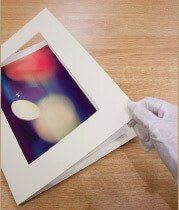
This guide provides basic information on the storage and preservation of digitally-printed photographs in scholarly and cultural collections. While there are many printing technologies for output from computers, this guide focuses on the three most popular forms of image (i.e. pictorial) hardcopy:
- Inkjet
- Digital electrophotography
- Dye sublimation
Information on recommended storage conditions, selection of housing and framing materials, proper handling and display are included. Collection care personnel in cultural institutions are the intended audience for this guide, however, it will also be useful to photographers, artists, and the general public.
Digital Print Perservation Portal (DP3)
Since 2007, the Image Permanence Institute (IPI) has been evaluating the stability of digitally printed materials and developing techniques for mitigating damage and extending their useful lives. Years of laboratory research have characterized the strengths and particular vulnerabilities of the major digital printing materials and technologies. Results have led to some significant conclusions on the preservation of these objects including:
- Digitally-printed photographs are highly variable in their sensitivities to decay forces
- Cold storage significantly reduces deterioration rates caused by natural aging and pollution, especially for inkjet
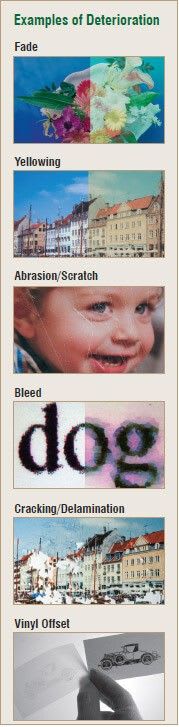
- Prints made using pigment inkjet can be very sensitive to abrasion
- Inkjet dyes can bleed when exposed to high humidity even for short periods
- Prolonged exposure to light can cause fade, yellowing, and embrittlement of both dye and pigment inkjet-printed photographs

All of the work has been under the umbrella of the DP3 (Digital Print Preservation Portal) Project. Funding for the DP3 Project was provided by grants from The Andrew W. Mellon Foundation and the Institute of Museum and Library Services (IMLS). This guide presents a summary of research results with recommendations for preservation. The project website, www.DP3Project.org, contains all of IPI's scientific research in this area as well as supplementary information to aid in the care of digitally-printed photographs including descriptions of the materials and technologies for each type, an online print identification tool, examples of deterioration, best practices for care, and additional resources.
Storage Conditions
A variety of harmful forces can affect collection objects in storage resulting in multiple decay manifestations. For digital prints the primary drivers of deterioration are heat, moisture, and air pollutants, though each print type has its own unique sensitivities. Signs of decay include image fade, paper yellowing, ink bleed, and cracking or delamination of paper layers. Table 1 shows the types of damage that can result from each environmental factor. Control of temperature, humidity, and air quality can significantly extend the lives of these materials.
It should be noted that the sensitivities of digitally-printed photographs to damage are highly variable and product dependent. At times the behavioral differences between materials within a category are greater than those between categories. For example, photos printed on two different manufacturers' inkjet printers using equivalent ink and paper types can have radically different deterioration rates due to subtle variations in colorant and paper formulations. For this reason all objects should be treated as individually as possible with condition assessments made on a regular basis.
Temperature and Humidity Recommendations
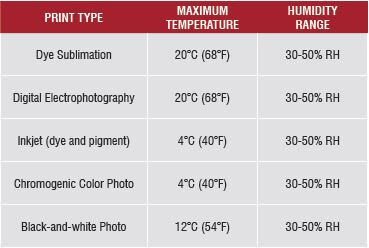
As with most collection materials, temperature and relative humidity (RH) control the natural aging rates of digital prints. Extremes of either can cause significant additional damage that would not occur under proper storage conditions. IPI data has shown that, in the absence of pollutant gases, digital print inks, dyes, and toners are fairly robust at room temperature and moderate humidity. However, many of the inkjet printing papers can be prone to significant yellowing and even deterioration of the ink receiver coatings. Lower temperatures can reduce these rates of decay. For this reason IPI recommends cold storage for inkjet prints.
The recommended maximum storage temperatures and relative humidity ranges for each digital print process, based on IPI's data from the DP3 Project, are shown in Table 2. Recommendations from the IPI Media Storage Quick Reference (MSQR) for traditional blackand- white and color photographs are provided for comparison. Note that the recommendations for inkjet supersede those of the MSQR which was published before the extensive digital print preservation research at IPI.
Table 1. Risk Factors for Storage Envionments
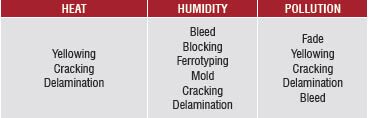
Table 2. IPI's Recommendations for Digital Print Storage

Humidity Extremes and Inkjet
High humidity should be avoided for all photograph types to prevent blocking, ferrotyping and mold growth. However, inkjet dyes can also bleed severely when exposed to high humidity causing noticeable image blurring and color fringing. Figure 1 shows the time to bleed for a susceptible inkjet print at 25°C (77°F). All conditions to the right of or in the dark gray area should be avoided. Prints should be safe below 65% RH. However, time to bleed rapidly diminishes as RH increases. Prints equilibrated to 80% RH or higher can show noticeable bleed in less than 24 hours. Very low humidity should also be avoided as it can exacerbate brittleness of some inkjet print layers making handling more risky. Like traditional photographs, digital prints should always be handled in RH conditions above 25%. This will be especially true for prints that have been on display because light and pollution exposure can increase the brittleness of surface layers over time.
Simplified Mixed Photograph Storage
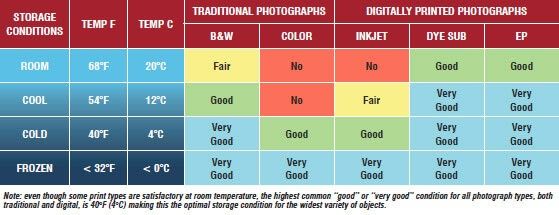
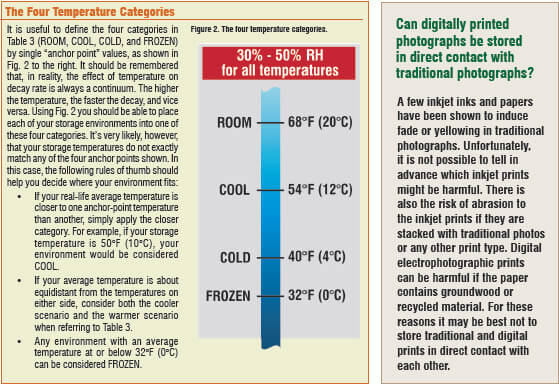
Since few institutions can provide special storage areas solely for digitally-printed photographs, these objects will need to be integrated with other collection materials. Fortunately, the basics of traditional photograph care can, with a few exceptions, be applied to digitally-printed photographs. IPI's MSQR provides information on thoughtfully merging multiple traditional media collection types into four or fewer common storage conditions. Table 3 provides qualitative ratings for each material at each storage condition and Table 4 defines the rating system. The temperatures in Table 3 correspond to general storage categories from the IPI MSQR.
Figure 1. Dye Inkjet bleed limits on an inkjet print at 25°C (77°F)
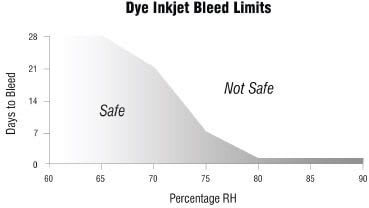
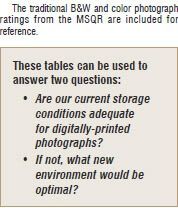
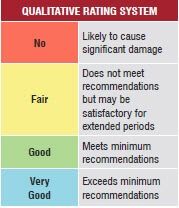
Table 3. Mixed Media Collections
Air Pollution
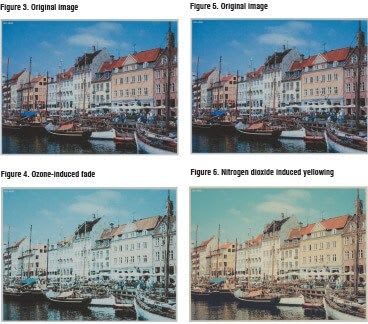
Pollution comes from a variety of sources including the air in the storage environment, housing and framing products, adjacent collection materials, and from within the object itself. Of these, the greatest threats to digital prints are air pollution and poor quality/reactive enclosures. Enclosures are addressed more fully on page 5. A variety of gases in the air can cause damage to digitally-printed photographs. Oxidizing agents such as ozone can cause fade or yellowing of many print types as well as embrittlement of inkjet paper coatings. Nitrogen dioxide can induce yellowing in all print types and bleed in some dye inkjet prints. For these reasons, exposure to air that has not been adequately filtered must be minimized. The reduced storage temperatures recommended on page 2 can help mitigate pollution-induced damage, but they are not equally effective for all gases. Nitrogen dioxide is strongly impeded, while ozone attack is only marginally slowed. Enclosures of low permeability, such as polyester sleeves, are helpful in reducing the rate of pollutant damage.
Housing and Framing Materials
Storage enclosures should provide physical protection for the object and should not pose a physical or chemical threat. Potential problems associated with enclosures include abrasion (resulting in scratches, scuffing, or smearing of colorants), yellowing of paper supports, and blocking or ferrotyping of print surfaces.
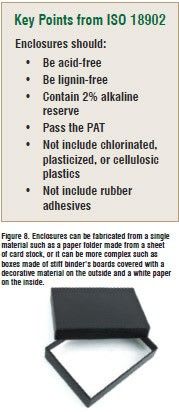
The approach suggested here is based on ISO Standard 18902 Imaging materials - Processed imaging materials - Albums, framing and storage materials, as well as research completed as part of the DP3 Project. A majority of potential problems will be averted if, at the very least, this standard is utilized when selecting storage materials. We recommend that institutions purchase Standard 18902 and become familiar with its requirements.
The ISO Standard can be applied directly to both dye sublimation and digital electrophotography. It is worth noting that vinyl plastic (PVC) enclosures should not be used with any imaging material - this is especially true for electrophotography because the plasticizers in the sheet can soften toner and pull it from the surface of the print.
It is more difficult to select safe enclosures for inkjet because of the diversity of ink and paper formulations used as well as their individual chemical and physical responses to enclosure materials. The ISO Standard is not completely satisfactory for inkjet prints due to some unique issues associated with certain damage types including adhesive-induced yellowing and bleed as well as abrasion.
While ISO 18902 allows the use of pressure sensitive adhesives (PSA) directly on photos for mounting purposes, these adhesives should not be used directly on inkjet photographs. This applies to either dye or pigment inkjet. While most PSAs will be non-reactive, some can cause deep yellowing in a matter of months. The chemical mechanism of this problem is not yet known and no test method exists to predict the reaction. For these reasons, no PSA should be applied directly to an inkjet photograph even if it meets ISO 18902 or passes the Photographic Activity Test (PAT).
Water-based adhesives (such as starch pastes used for hinging) should not be used on the verso of printed areas in dye inkjet prints because the moisture can migrate through the paper and induce bleed of the colorants. They may be carefully applied to areas that are not directly behind colorants such as white borders. Additionally, adhesives that remain hygroscopic after drying can pull additional moisture into a print over time, further damaging dye-based images.
The surface of pigment inkjet prints, or dye inkjet that used pigment for the black ink, can be extremely sensitive to abrasion. For this reason only smooth plastic films, such as polyester sheeting, should be used in contact with print surfaces. The optimal approach is not to allow any material to contact the print's surface. This can be achieved by using window mats to keep the objects separated while stacked. This may not be possible for extremely large prints, in which case smooth plastic interleaving and extreme care should be used.
Display Recommendations
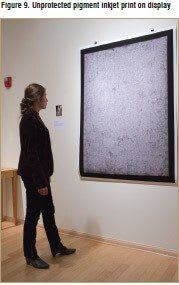
The major concerns for digital prints on display are fade of the colorants, yellowing of the papers, and/or embrittlement of surface coatings. Exhibition procedures should follow established practices for chromogenic prints such as the American Institute for Conservation of Historic and Artistic Works Photographic Materials Conservation Catalog - Exhibition Guidelines for Photographic Materials. The primary cause of damage is ultraviolet (UV) radiation; however, energy in the visible spectrum can also contribute to decay. Digital prints should be framed with glazing to physically protect the surface and to protect against pollutant exposure. The glazing should block at least 97% of the UV energy. Framing materials should meet the requirements described above. As with storage spaces, environmental conditions have a major impact on the decay rate of material in exhibition areas. Exposure to extremes in humidity and high levels of pollutants must be avoided. Limiting display times and routine monitoring of prints on display can prevent noticeable and objectionable change.
Handling Practices
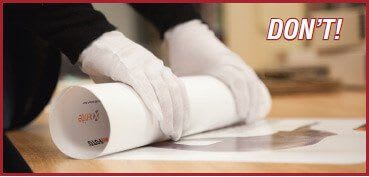
The primary concerns when handling prints include abrasion of the surface (scratching, scuffing, and smearing of colorants) and cracking (with or without flaking of print surface layers). The following practices should be used to minimize the potential for damage.
Wear Gloves
Gloves should always be used when handling photographic materials. There is no scientific evidence supporting a preference for nitrile or cotton gloves for digital prints; however, there are reasons to prefer nitrile to cotton for many collection objects including digital prints. They fit better, they don't tend to snag on edges, and they don't allow contaminants to migrate through the glove over time.
Use Secondary Supports
Avoid touching the image areas in prints even with gloves. Hold prints at edges or underneath. The use of a secondary support such as a mat board is preferred. This will prevent abrasion of the print's surface by the fingers as well as unintended flexing of the print which can lead to surface cracking or crimping. In addition, inkjet prints that have been on display may have become imperceptibly brittle. This can be true even when other types of decay such as color fade or paper yellowing are not apparent. Flexing such a print may initiate cracking or even delamination of paper coatings.
Avoid Stacking or Rolling
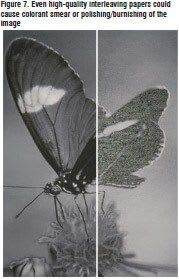
Pigment inkjet prints, especially on soft, fine ar t papers, can be extremely sensitive to abrasion and scratching. Prints should not be piled directly on top of each other. Interleaving should be done using very smooth materials such as polyester sheeting. Even high-quality interleaving papers can cause colorant smear or polishing/burnishing of the image. Prints should not be rolled, as this stresses the image receiver layer and puts the print's inked surface in direct contact with the paper's verso which can result in abrasion damage. Additionally, prints should always be allowed to fully dry post-printing before handling or interleaving to prevent spotting, ferrotyping, or blocking.

Digital Print Types
Three technologies are used to print the majority of digital images: inkjet, digital electrophotography, and dye sublimation. None of these technologies were originally developed for computer output. Each process has an analog predecessor, which was only later modified to print digital photographs.
Inkjet Prints
The first device to utilize drops of ink emitted from a nozzle was developed by William Thomson (Lord Kelvin) in 1867 to record telegraph transmissions. It was not until over a century later that inkjet printing devices were adapted for computers and became commercially available. In 1984, Hewlett Packard introduced the first desktop inkjet printer. From then, rapid developments in technology led to improvements in print quality, the inclusion of color, and the printing of photographic images. Other major advances included desktop color inkjet in 1987, wideformat printing in 1993, full-color pigment inkjet in 2000, and inkjet digital presses in 2007.
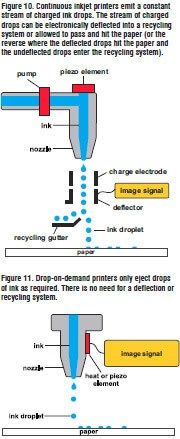
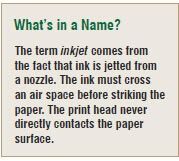
All inkjet printers use drops of ink emitted from nozzles to create colored dot patterns on paper or other printing substrates. There are two main types of inkjet printers - continuous and drop-on-demand. Continuous inkjet printers were the first to be used for high-end, fine-art inkjet images. The technology's original purpose was for creating proofs in commercial printing facilities. Continuous inkjet printers emit a constant stream of charged ink droplets. The drops are either electronically deflected into a recycling system or allowed to pass and strike paper that is attached to a rotating cylinder. A variety of papers can be used as long as they are flexible enough to fit around the printing drum.
Drop-on-demand printers eject drops of ink only as required. There is no need for a deflection and recycling system. There are two different ways in which ink can be forced from the printing nozzle. The first, called thermal inkjet printing (also known as bubble jet printing), utilizes a heating element inside the print head to temporarily vaporize some of the ink and create a bubble. The formation of the bubble forces a drop of ink out of the nozzle. In the second type, a ceramic piezoelectric tile flexes into the ink reservoir in the print head and physically forces the drop from the nozzle. All desktop inkjet printers and most wide format printers use drop-on-demand technology.
Inkjet inks can be water-based (aqueous), solvent-based, or UV-curable. The majority of inkjet-printed objects in cultural collections will have been created using aqueous inks.
The solvent and UV-curable inks are primarily used for industrial and commercial applications and only rarely for photograph or fine art printing. Inkjet colorants may be either dyes or pigments. Dyes are organic compounds that are soluble. Pigments are inorganic, organic, or a combination of both, but they are always insoluble in the ink liquid. Inkjet printers use either dyes, pigments, or a mixture of the two where the colors are dyes and the black is pigment. In general, prints made with pigment colorants have tended to be more resistant to environmental deterioration (moisture, pollution, light), while those made with dyes have been more durable during handling. Inkjet ink sets can be larger than those used in other printing methods. Inkjet printers used for pictorial images often have more colors of ink than the basic cyan, magenta, yellow, and black. High-end inkjet photo printers include inks of varying tone (such as greys, light cyan, and light magenta) as well as other hues (such as orange, red, green, blue, or violet) to improve the range of colors that can be produced.
A variety of papers are used to create inkjet photographs. Because plain paper absorbs the ink in ways that diminish color and line
quality, paper manufacturers have created special coatings for inkjet papers. These very thin layers are intended to keep the ink at the paper's surface and to make colors brighter and lines sharper.
Coatings were first applied to enable inkjet printing on fine art papers such as watercolor paper. Such coatings typically consist of mineral particles in a polymer binder. Dyes and pigments flow into the spaces between the particles and become adsorbed onto the surfaces. Papers with this type of coating are referred to as "porous papers." Early on, the mineral particles were too large to form a smooth glossy surface, so the papers were always matte or took on the texture of the underlying paper's surface.
As inkjet printing of photographs grew more popular, manufacturers attempted to make papers that looked like chromogenic prints on resin-coated (RC) papers. RC papers are coated on both sides with a thin polyethylene layer. The layer on the back is clear to show company logos printed on the paper back, while the layer on the front is pigmented white to make the image appear very bright. Two different types of coatings can be applied to the front side of RC papers to accept the inkjet inks; polymer and porous.
The coating on polymer inkjet RC paper swells and absorbs the aqueous inks as they are ejected onto the paper by the printer. These papers are typically used only with dye inks because many pigment particles are too large to be absorbed into the coating. There are several advantages to these papers. One is that they can be manufactured to a higher gloss than the porous-coated papers-a look that is preferred by many photographers. Also, because the ink is absorbed fully into the polymer layer, the prints are more resistant to abrasion or fading from airborne pollutants. In recent years, these papers have become less popular because they can take several minutes to several hours to fully dry. Handling polymer-coated prints
Digital Print Types
while they are still wet can lead to smudging of the colorants. They are also sensitive to high humidity bleed.
Porous coatings are similar to those first used on fine art watercolor and etching papers. What differentiates the porous photo paper is the RC support to which the mineral coating has been applied, as well as the size of the particles used in the coating. In addition to being coated on a plastic laminated support, the particles used in the ink receiver layer are smaller and more tightly compacted than in most fine art papers significantly increasing the apparent glossiness of the paper's surface. One disadvantage is that while porous photo papers are often advertised as glossy, they are not as glossy as polymer inkjet or traditional chromogenic glossy photos. Also, because the pores remain open even after drying, the colorants are not protected from the environment and are more susceptible to pollution-induced fade. Porous photo papers can be used with both dye and pigment inkjet printers.
Baryta inkjet papers are designed to look and feel like fiber-based silver-gelatin prints. Many professional photographers and artists wanted photo papers that resembled the black-andwhite papers they had been using for traditional photography. For this reason manufacturers began to produce "baryta" inkjet papers. These papers may or may not actually use baryta, but what is common to all is the application of a white smoothing layer between the paper surface and the porous ink receiver layer. The reverse side is not coated, or laminated with polyethylene like RC paper, in order to maintain that fibrous paper 'feel'.
Dye Sublimation Prints
The concept of dye sublimation was first discovered by Noel de Plasse in 1957. As an engineer for the French textile company Lainière de Roubaix, he discovered that at high temperatures certain dyes would change from solids directly into gases and then, on cooling, revert to solid dyes. This discovery was not applied to imaging until 1982 when the Sony engineer, Nobutoshi Kihara, used it to print images from a still video camera. It took another four years before the technology became commercially available in 1986. This is the earliest year for these prints to have appeared in collections.
In these systems, the image-forming colorants are transferred to the print paper from colored donor ribbon. The printer modulates heat energy to the ribbons to control the amounts of yellow, magenta, and cyan dyes that are transferred.
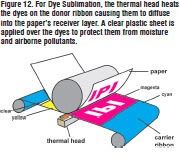
This technology is most often used in snapshot-size photo printers and in commercial photo kiosks and has the advantage of producing images very rapidly compared to traditional photographic processing.
All dye sublimation printers use cyan, magenta, and yellow dyes to create the image. The papers are made using the same RC support that is used for chromogenic prints so that they look and feel like "real" photographs. The top layer that receives the heated dye is polyester, as it readily receives the super-heated dyes.
An important step in the evolution of the technology came in 1994 when protective overcoats began to be applied after printing of the colored dyes. Before this, dye sublimation images were unprotected and very susceptible to damage by light, pollution, humidity, heat, and water. Prints created before or about 1994 should be treated with a high degree of care as they will be very sensitive to use and exhibition.
Digital Electrophotographic Prints
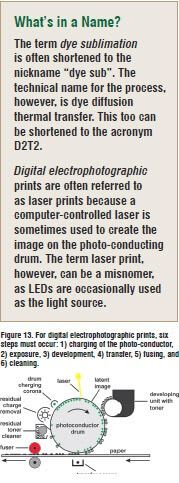
Modern, digital electrophotographic printers are based on the technology long used in analog photocopiers. Chester Carlson invented the electrophotographic process in 1938 which was first commercialized in 1949. The conversion from analog to digital came in 1969 when Gary Starkweather of Xerox used a computerdriven laser to expose a photo-copier's photoconducting drum and thus created the first laser printer. IBM, however, was first to market with its 3800 laser printer in 1976. These devices were not desktop models, but room-sized machines that only large organizations, such as major corporations, would use. The first desktop version of the electrophotographic laser printer, the HP LaserJet, came out in 1984. The first desktop color electrophotographic laser printer became available in 1993.
Also in 1993, both dry- and liquid-toner full-color digital presses were introduced. These large scale devices, used by commercial printing houses,
can print single copies or thousands with each imprint being unique. These new printers have two major advantages over traditional offset lithography. First is the ability to print on-demand. The digital presses do not need printing plates and therefore the time required to make them and tune their performance on the printer. Secondly, unlike offset printers which make a large number of copies of a single impression, the digital printers can make each page unique in what is known as variable-data printing. This feature has been utilized by the imaging industry to create photo books which are individualized collections of personal photos printed and bound in a singlecopy book format.
Digital electrophotography uses nearly the same technology as an analog photocopier with the main difference being how the photoconducting drum is exposed. In the photocopier a document was placed face down on a glass platen. Light was then reflected off white areas of the object onto the drum causing selective exposure. In the laser printer, an electronic file
Digital Print Types
containing the print data controls a laser which sweeps back and forth across the drum, turning on to expose certain areas and off to leave other areas unexposed. The unexposed areas can attract the colored toner, which can then be transferred and fused to the paper. For a digital electrophotographic printer to create color images, four separate impressions (one each for cyan, magenta, yellow, and black toners) must be made.
The coloring agents used in digital electrophotographic systems are called toners. They come in two forms - dry and liquid. Dry toners are used in all current desktop and office printer/copier systems. Both dry- and liquidtoner systems are used in electrophotographic digital presses. Dry toners consist of pigments embedded inside polymer beads. The fusing process melts the polymer beads to the surface of the paper. Liquid-toners likewise use pigments in polymer beads; however, they are dispersed in a volatile oil that evaporates during the fusing process. For black-and-white printers the colorant is carbon black which is typically very stable. Therefore, black-and-white electrophotographic prints made on high-quality alkaline papers should be very long-lasting. For color toners, a variety of pigment substances can be used. The stability of these can vary between manufacturers.
The papers used for digital electrophotography can be either uncoated or coated. The majority of desktop or office printer papers are uncoated and are usually referred to as plain paper, office paper, or copier paper. Coated papers are similar to plain papers with the exception that a heavy mineral layer has been applied to the surface during manufacture to increase the papers' density, opacity, and surface smoothness. This is the type of paper we find in glossy magazines. It's also often used in brochures, booklets, and posters. Coated papers are only occasionally used in desktop or office electrophotographic printing but are commonly used on digital presses.
Glossary
Baryta: A mixture of gelatin and the white pigment barium sulfate.
Bleed: Migration of colorants through or across the surface of a print.
Blocking: Unintended bonding together of materials in direct contact.
Chromogenic print: Traditional wet-processed color photographic print.
Colorant: A substance (dye or pigment) that imparts color to an ink or toner.
Colorant Smear: Spread of colorant from dark to light areas within a print caused by abrasion.
Color fringing: Bleed of a single colorant within an image containing multiple colorants such that the bled color appears strongly along image edges.
Delamination: Separation of layers in a print.
Dye: An organic colorant soluble in the ink vehicle.
Ferrotyping: a change in surface gloss due to intimate contact with an adjacent surface under high humidity, temperature, and/or pressure.
Ink Receiver Layer (IRL): The layer on the surface of inkjet printing papers to which the colorant is applied
Overcoat: A clear layer applied after printing to protect the image.
Pigment: An organic or inorganic colorant insoluble in the ink vehicle.
Polishing/burnishing: Compression of colorants on a print's surface resulting in an increase in glossiness.
Polyvinyl chloride (PVC): A clear plastic film occasionally used in storage enclosures.
Resin-coated paper (RC): A paper that has been coated with polyethylene film on both sides.
Sublimation: The conversion of a solid directly to a gas.
Toner: Dry or liquid coloring substance used in electrophotographic printers.
Resources
Adelstein, Peter, IPI Media Storage Quick Reference, 2nd Edition, Image Permanence Institute, NY, USA, 2009.
Grattan, David, The Stability of Photo-copied and Laserprinted Documents and Images: General Guidelines (Technical Bulletin 22), Canadian Conservation Institute, Ottawa, ON, Canada, 2000.
ISO18902:2013 Imaging materials - Processed imaging materials - Albums, framing and storage materials, International Organization for Standardization, Geneva, Switzerland, 2013.
ISO18920:2011 Imaging materials - Reflection prints - Storage practices, International Organization for Standardization, Geneva, Switzerland, 2011.
ISO 18934:2011 Imaging materials - Multiple media archives - Storage environment, International Organization for Standardization, Geneva, Switzerland, 2011.
Jurgens, Martin, The Digital Print: Identification and Preservation, The Getty Conservation Institute, Los Angeles, CA, 2009.
Watkins, Stephanie, compiler, Exhibition Guidelines for Photographic Materials, American Institute for Conservation of Historic and Artistic Works Photographic Materials Conservation Catalog, www.conservation-wiki.com, 2004.
About the image permanence institute
IPI is a nonprofit, university-based laboratory devoted to preservation research. It is the world's largest independent laboratory with this specific scope. IPI was founded in 1985 through the combined efforts and sponsorship of the Rochester Institute of Technology and the Society for Imaging Science and Technology. Funding for IPI's preservation research and outreach efforts has come primarily from the National Endowment for the Humanities, the Institute of Museum and Library Services, and The Andrew W. Mellon Foundation. IPI provides information, consulting services, practical tools, and preservation technology to libraries, archives, and museums worldwide. The imaging and consumer preservation industries also use IPI's consulting, testing, and educational services.
Websites
- ImagePermanenceInsititute.org
- GraphicsAtlas.org
- DP3Project.org
- Dew Point Calculator (www.dpcalc.org)
- eClimateNotebook.com
- Sustainable Preservation Practices (www.ipisustainability.org)
Mission
The Image Permanence Institute (IPI) is a recognized world leader in the development and deployment of sustainable practices for the preservation of images and cultural property. IPI accomplishes this through a balanced program of research, education, products, and services that meet the needs of individuals, companies, and institutions.
What We Do
Since its inception in 1985, the Image Permanence Institute has provided cultural institutions, preservation scientists, and consumer preservation industries in the US and abroad with significant research, publications, and tools to enable the preservation of image collections and material culture. Our resources are committed to specialized scientific research, the development of up-to-date standards and reliable tools, and the dissemination of useful and understandable information to a broad range of cultural institutions and media consumers.
© 2014, Image Permanence Institute
Visit our website at www.dp3project.org to learn more about IPI's digital print research, education, and outreach activities.
This publication was made possible through projects funded by The Andrew W. Mellon Foundation.
Additional research was funded by the Institute of Museum and Library Services.

Image Permanence Institute
Rochester Institute of Technology
70 Lomb Memorial Drive
Rochester, NY 14623-5604
www.imagepermanenceinstitute.org
(585) 475-5199